
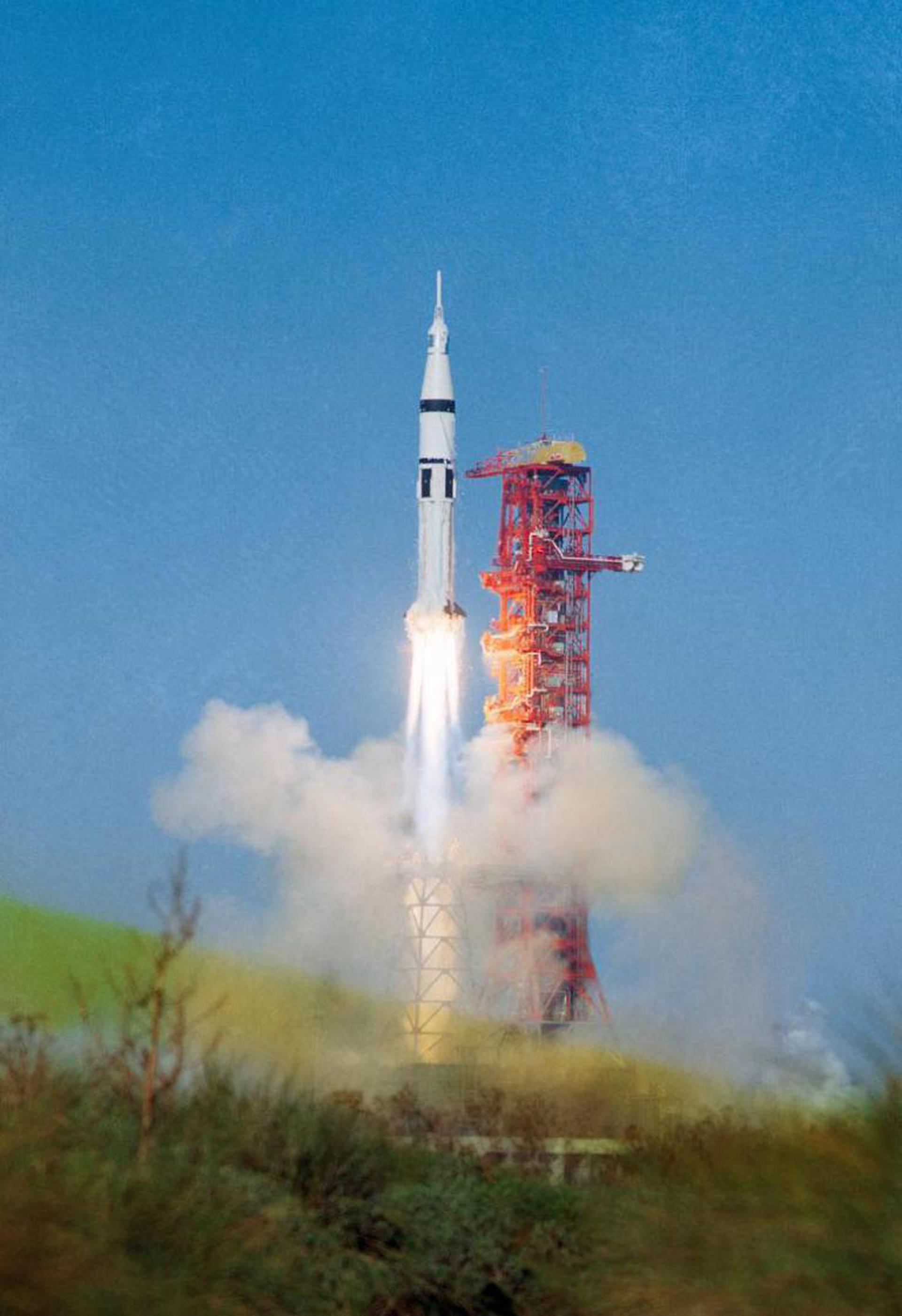
Saturn IB | Apollo 1 (Failure before launch)
National Aeronautics and Space Administration
Mission Status
Either the launch vehicle did not reach orbit, or the payload(s) failed to separate.
Mission Details
Apollo 1, initially designated AS-204, was the first crewed mission of the United States Apollo program, the undertaking to land the first man on the Moon. It was planned to launch on February 21, 1967, as the first low Earth orbital test of the Apollo command and service module. The mission never flew; a cabin fire during a launch rehearsal test at Cape Kennedy Air Force Station Launch Complex 34 on January 27 killed all three crew members—Command Pilot Gus Grissom, Senior Pilot Ed White, and Pilot Roger B. Chaffee—and destroyed the command module (CM). The name Apollo 1, chosen by the crew, was made official by NASA in their honor after the fire.
Rocket Configuration
The Saturn IB (pronounced "one B", also known as the Uprated Saturn I) was an American launch vehicle commissioned by the National Aeronautics and Space Administration (NASA) for the Apollo program. It replaced the S-IV second stage of the Saturn I with the much more powerful S-IVB, able to launch a partially fueled Apollo Command/Service Module (CSM) or a fully fueled Lunar Module (LM) into low Earth orbit for early flight tests before the larger Saturn V needed for lunar flight was ready.